Perspective Type #
The perspective_type parameter defines the viewpoint from which planetary positions are calculated. PerspectiveType has eleven members; the four below cover nearly all astrological work.
Available Perspective Types #
| Perspective | Description | Use Case |
|---|---|---|
Apparent Geocentric |
Earth-centered, accounting for light-time and aberration. Default and standard for most astrology. | Traditional natal, synastry, transit charts |
True Geocentric |
Earth-centered, without light-time correction. Positions as they “truly” are at that moment. | Research, comparison with astronomical data |
Heliocentric |
Sun-centered. Shows planetary positions as seen from the Sun. Earth replaces Sun in the chart. | Esoteric/cosmobiological techniques, solar system studies |
Topocentric |
Observer’s exact location on Earth’s surface. Most accurate for Moon position. | Precise lunar work, electional astrology |
The other seven place the observer on another body or at the solar-system
barycentre: Selenocentric (the Moon), Mercurycentric, Venuscentric,
Marscentric, Jupitercentric, Saturncentric, and Barycentric. Each drops
the point it is centred on, since a body has no position as seen from itself.
Apparent Geocentric (Default) #
This is the standard perspective for almost all astrological work. It accounts for the time light takes to travel from celestial bodies to Earth.
from kerykeion import AstrologicalSubjectFactory

# Default perspective - no need to specify
subject = AstrologicalSubjectFactory.from_birth_data(
    "John Lennon", 1940, 10, 9, 18, 30,
    lng=-2.9833, lat=53.4, tz_str="Europe/London",
    online=False,
    # perspective_type="Apparent Geocentric"  # This is the default
)

print(f"Sun: {subject.sun.sign} {subject.sun.position:.2f}°")
print(f"Moon: {subject.moon.sign} {subject.moon.position:.2f}°")
Output:
Sun: Lib 16.27°
Moon: Aqu 3.55°
Heliocentric #
In heliocentric charts, we view the solar system from the Sun’s perspective. The Earth appears in the chart instead of the Sun.
from pathlib import Path
from kerykeion import AstrologicalSubjectFactory
from kerykeion.chart_data.factory import ChartDataFactory
from kerykeion.charts.drawer import ChartDrawer

from kerykeion.settings.config_constants import DEFAULT_ACTIVE_POINTS

subject = AstrologicalSubjectFactory.from_birth_data(
    "John Lennon - Heliocentric", 1940, 10, 9, 18, 30,
    lng=-2.9833, lat=53.4, tz_str="Europe/London",
    online=False,
    perspective_type="Heliocentric",
    # Heliocentric excludes the Sun automatically, but Earth is NOT added
    # by default — opt in explicitly to chart it.
    active_points=[*DEFAULT_ACTIVE_POINTS, "Earth"],
)

print(f"Earth: {subject.earth.sign} {subject.earth.position:.2f}°")
print(f"Mars: {subject.mars.sign} {subject.mars.position:.2f}°")

data = ChartDataFactory.create_natal_chart_data(subject)
chart = ChartDrawer(data)

out_dir = Path("charts_output")
out_dir.mkdir(exist_ok=True)
chart.save_svg(output_path=out_dir, filename="lennon-heliocentric", style="classic")
Output:
Earth: Ari 16.27°
Mars: Vir 24.51°
The chart will be:
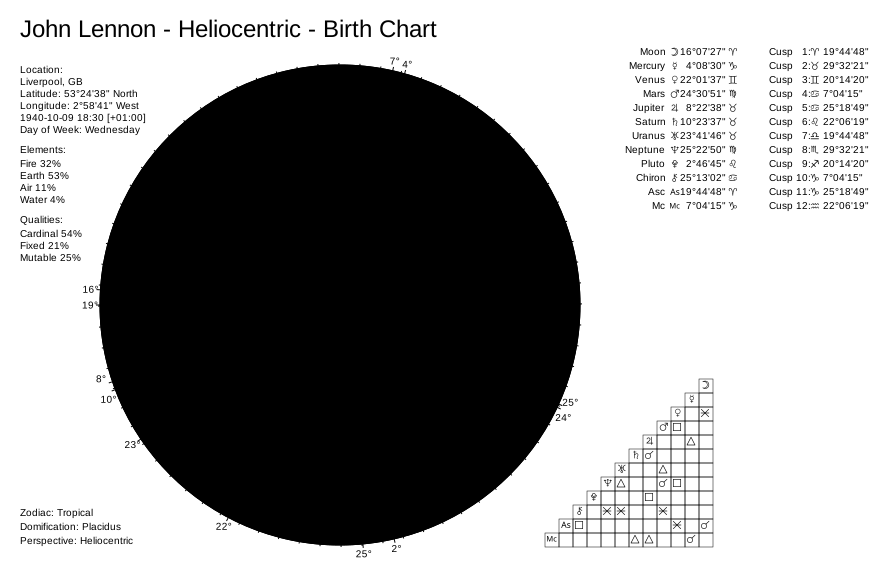
Note: Heliocentric charts still compute houses and the angles — the Ascendant and MC come from the observer’s clock and place, which the subject carries regardless of where the planetary longitudes are measured from. What the perspective drops are the Sun (it is the centre) and the geocentric-only points: the lunar nodes and the Lilith / apogee variants. Both exclusions are logged.
True Geocentric #
Shows positions without light-time correction. The difference from Apparent Geocentric is typically very small (a few arcseconds for most planets).
from kerykeion import AstrologicalSubjectFactory

# True geocentric perspective
subject = AstrologicalSubjectFactory.from_birth_data(
    "John Lennon - True Geocentric", 1940, 10, 9, 18, 30,
    lng=-2.9833, lat=53.4, tz_str="Europe/London",
    online=False,
    perspective_type="True Geocentric",
)

print(f"Sun: {subject.sun.sign} {subject.sun.position:.4f}°")
Topocentric #
The most precise perspective for the Moon and fast-moving points. Accounts for the observer’s exact location on Earth’s surface (parallax correction).
from kerykeion import AstrologicalSubjectFactory

# Topocentric for precise Moon position
subject = AstrologicalSubjectFactory.from_birth_data(
    "John Lennon - Topocentric", 1940, 10, 9, 18, 30,
    lng=-2.9833, lat=53.4, tz_str="Europe/London",
    online=False,
    perspective_type="Topocentric",
)

print(f"Moon: {subject.moon.sign} {subject.moon.position:.4f}°")
print(f"Ascendant: {subject.first_house.sign} {subject.first_house.position:.4f}°")
Comparing Perspectives #
from kerykeion import AstrologicalSubjectFactory

perspectives = ["Apparent Geocentric", "True Geocentric", "Topocentric"]

for perspective in perspectives:
    subject = AstrologicalSubjectFactory.from_birth_data(
        "Test", 1990, 6, 15, 12, 0,
        lng=-0.1276, lat=51.5074, tz_str="Europe/London",
        online=False,
        perspective_type=perspective,
    )
    print(f"{perspective}:")
    print(f"  Moon: {subject.moon.position:.4f}°")
Output:
Apparent Geocentric:
  Moon: 14.8016°
True Geocentric:
  Moon: 14.8018°
Topocentric:
  Moon: 13.9628°
The topocentric figure is nearly a degree away: that is lunar parallax, and it is why the Moon is the point the perspective matters most for.
Tip: For most astrological work, stick with the default
Apparent Geocentric. UseTopocentriconly when precise Moon timing is critical (e.g., for electional astrology or void-of-course Moon calculations).